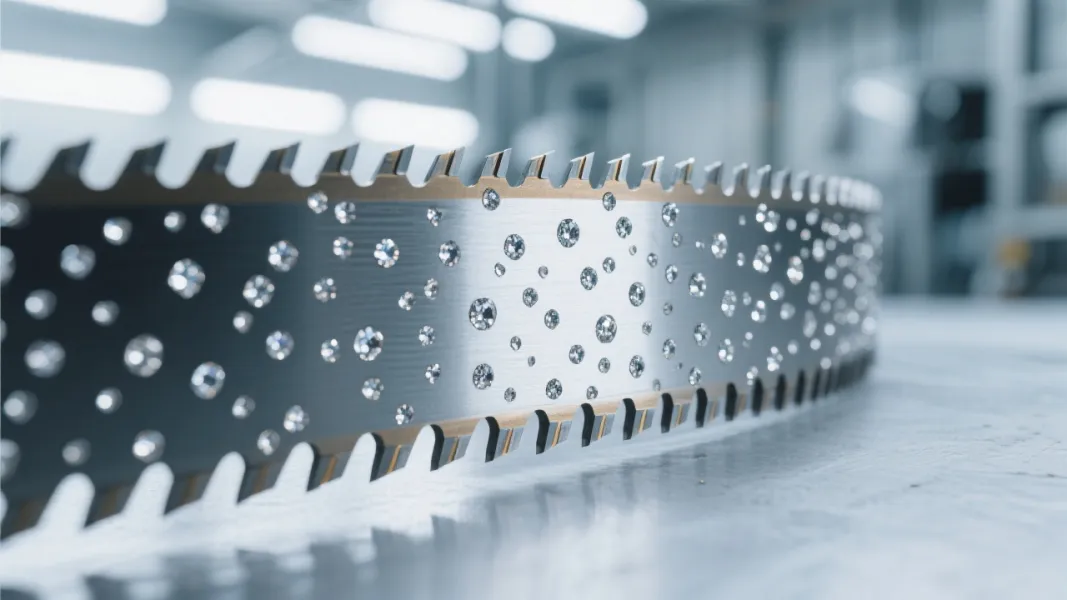
400mm Brazed Diamond Saw Blade: Enhanced Bond Brazing and Alloy Core for Stable Cutting
2026/02/17
UHD
Technical knowledge
This article explains how a 400mm brazed diamond saw blade achieves efficient, stable cutting in demanding hard-material applications. It focuses on the enhanced-bond brazing process used by UD Superhard and the advantages of a high-strength alloy core, detailing diamond grit embedding mechanics, particle size and density selection, and how these choices match the base material to improve edge retention and service life. It also breaks down heat-dissipation slot/fin design for lower operating temperatures, plus vibration-control features that support safer handling and consistent accuracy. Wet and dry dual-mode use cases are mapped to typical jobsite conditions, while CE-aligned quality controls are interpreted to strengthen confidence in compliance and traceability. Finally, real-world scenarios such as municipal concrete cutting and granite processing are used to connect theory to practice, including maintenance tips and guidance on selecting the right configuration. For project-specific needs, the article highlights availability of customization services and after-sales service support, with a call to visit the official website for tailored solutions.
In hard-material cutting, the difference between a “good” blade and a production-grade blade is rarely marketing—it is thermal balance, diamond exposure efficiency, and bond integrity under shock loads. A 400mm brazed diamond saw blade built with enhanced-bond brazing and a high-strength alloy steel core is designed to keep diamond particles working at a consistent protrusion height, while controlling heat and vibration that typically cause premature glazing, segment breakage, and wandering cuts.
Enhanced-Bond Brazing: The Real Upgrade Over Conventional Joining
Conventional sintered or welded diamond blades rely on a matrix that gradually releases diamonds. In contrast, a brazed blade uses a high-temperature filler metal to create a strong metallurgical bond between the diamond and the segment surface. The value is straightforward: more effective diamond exposure from the first cut and less energy wasted on friction.
Brazing principle (in practical terms)
A controlled-temperature cycle (typically ~900–1,050°C depending on alloy system) wets the diamond surface and the alloy substrate. The enhanced-bond approach focuses on improving wetting and anchoring so diamonds resist pull-out under impact loads—especially important in granite and mixed aggregate concrete.
Dimension
Enhanced-bond brazed blade
Traditional welded / sintered blade
Initial cutting efficiency
High (diamonds exposed immediately)
Medium (needs matrix wear-in)
Diamond retention under shock
Strong anchoring; less pull-out
More prone to segment micro-cracks
Heat behavior (dry cutting)
Lower friction; better thermal stability
Higher friction; glazing more likely
Best-fit materials
Hard stone, dense concrete, abrasive mixes
General-purpose, softer aggregates
Diamond Grit Engineering: Density, Size, and Match to the Alloy Core
Industrial buyers often ask for “higher diamond content,” but performance comes from the right distribution density and grit size matched to the base alloy stiffness. Too dense and the blade runs hotter; too sparse and it chatters or slows under load. A 400mm brazed diamond saw blade is typically engineered around a balanced contact pattern so each diamond participates in cutting rather than rubbing.
Grit size selection (field-friendly guidance)
For faster stock removal on tough materials, manufacturers often use a grit range around 30/40 to 40/50. For a cleaner finish and improved edge control, a finer range like 50/60 can be chosen. The key is ensuring the brazed bond keeps a stable protrusion so diamonds shear material instead of polishing it.
Distribution density (why “more” isn’t always better)
Practical production blades often target a controlled diamond layout that keeps chip evacuation open. When kerf pockets remain clear, cutting temperature can drop by ~10–25°C under comparable feed rates, reducing glazing and extending effective life.
Alloy core match (stability under load)
A quality alloy steel core with consistent flatness helps maintain a straight cutting path. For 400mm blades commonly used on wall saws and table saws, core stiffness and stress balancing reduce lateral drift—critical when operators need accurate slots or expansion joints without overcut.
Thermal Management: Heat Sinks, Slots, and Why Temperature Controls Blade Life
Heat is the hidden cost driver in diamond cutting. When a blade runs too hot, the bond weakens, diamonds dull faster, and the core may warp. Modern 400mm brazed blades integrate heat-dissipation features—such as cooling slots and heat-sink geometries—to keep the cutting edge stable during long passes.
Operational benchmark (reference values)
In dry cutting on dense concrete, segment-edge temperatures can climb beyond 200–300°C during aggressive feed. Designs that improve airflow and reduce rubbing can measurably lower peak temperature, which is often correlated with fewer burn marks and a more consistent cutting sound.
Suggested infographic: Brazing & thermal workflow (for your page)
Step 1
Core prep & stress balancing
Step 2
Diamond layout & grit selection
Step 3
Enhanced-bond brazing cycle
Step 4
Cooling slot design & QC checks
Step 5
Field validation (wet/dry)
Vibration Control: Precision, Safety, and Operator Confidence
Vibration is not just discomfort—it is lost accuracy and higher risk. A 400mm blade running on a wall saw or high-power cutter can amplify small imbalances into a visibly wandering kerf. Anti-vibration slot patterns and tuned core stiffness help stabilize the blade’s natural frequency, reducing chatter on hard inclusions such as granite crystals or dense aggregate.
What users typically notice first
Cleaner cut line and reduced edge chipping on stone
Less “bouncing” at the start of the cut
More predictable feed pressure (lower fatigue over long shifts)
Wet vs. Dry Cutting: Dual-Mode Capability and Where Each Wins
Many industrial teams require flexibility: dry cutting for mobility and speed, wet cutting for dust control and thermal stability. A well-designed 400mm brazed diamond saw blade can support both modes, but the best results come from matching the mode to the job constraints.
Mode
Best for
Operational notes
Dry
Fast deployment, remote sites, short-to-medium cuts
Use staged passes; allow cooling pauses; monitor discoloration
Wet
Long cuts, dust-sensitive environments, best blade longevity
Intermittent water availability; varied materials on one shift
Start wet for thermal stability; switch dry for mobility when needed
CE Compliance and Quality Assurance: What It Means for Industrial Buyers
For procurement and compliance teams, “CE” is not a decorative label—it indicates a documented approach to safety and conformity for relevant EU requirements. For a cutting tool category, CE-aligned processes commonly emphasize traceability, consistent manufacturing controls, and risk reduction in operation.
Practical buyer checklist (what to ask your supplier)
Batch traceability for core material and brazing consumables
Flatness and runout inspection records (typical targets can be ≤ 0.2–0.4 mm depending on blade type and application)
Clear operating instructions and safety guidance for dry/wet conditions
Where It Performs: Two Typical Applications and What to Watch
Municipal works: road & sidewalk joint cutting
Mixed aggregate concrete can shift from abrasive to extremely dense within a few meters. Enhanced-bond brazing helps maintain diamond exposure when the blade hits hard stones, while cooling-slot design supports longer dry runs. Operators typically gain steadier tracking and fewer “stop-and-cool” interruptions when the workflow is set up correctly.
Use incremental depth passes for thick slabs
Keep the kerf clear; packed dust increases friction dramatically
Check flange cleanliness to avoid runout-induced vibration
Stone processing: granite trimming and sizing
Granite punishes unstable blades because micro-chipping can propagate quickly at the edge. With a stable alloy core and controlled diamond layout, a 400mm brazed blade can reduce chipping risk while keeping a fast cut rate. Wet cutting is often preferred here for both finish and temperature control.
Maintain steady coolant flow and slurry evacuation
Don’t force feed when entering dense quartz bands
Dress the blade if cutting speed drops (avoid prolonged rubbing)
Maintenance Logic: Extend Life by Protecting Diamonds and the Core
Blade longevity is rarely a mystery. When a blade “dies early,” it is often running too hot, too fast, or off-axis. A few disciplined checks protect the brazed bond, preserve diamond sharpness, and keep the core stable over time.
Field routine (simple, high impact)
Before cutting: verify arbor fit, flange condition, and no visible warping.
During cutting: keep a stable feed rate; avoid side loading and twisting in the kerf.
After cutting: clean slurry/dust; store flat to prevent deformation.
For OEMs, contractors, and distributors, the most reliable gains come from aligning blade design with the real job: material hardness, machine power, duty cycle, and dust/water constraints. This is where customization service becomes practical—not cosmetic—because grit size, diamond density, slot pattern, and core thickness can be tuned for a specific customer workflow. Equally important is an after-sales service guarantee that supports correct setup, troubleshooting, and repeatable performance across batches.
Need a 400mm Brazed Diamond Saw Blade Matched to Your Material and Machine?
Request a configuration plan based on your cutting mode (wet/dry), material type (concrete/granite), and machine power. Get recommended grit size, diamond layout, and cooling-slot design—plus documentation support, customization service, and after-sales service guarantee.





.png?x-oss-process=image/resize,h_600,m_lfit/format,webp)

.png?x-oss-process=image/resize,h_600,m_lfit/format,webp)