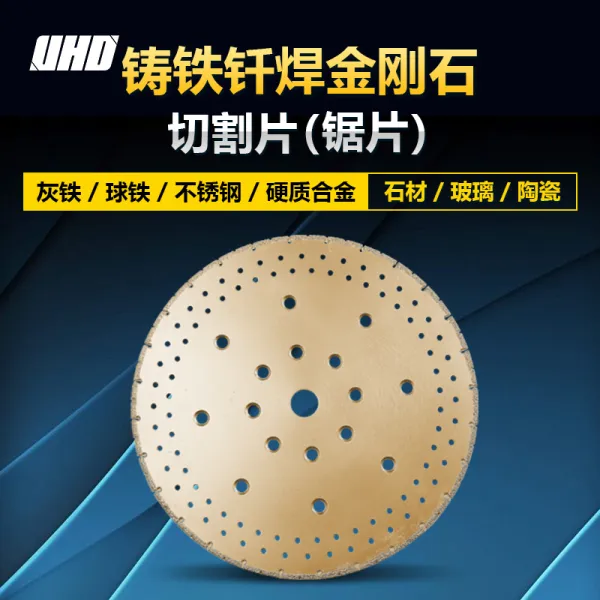
When using diamond saw blades for cutting, you may encounter the problem of excessive vibration. This issue not only affects the surface precision of the cut material but also poses risks such as equipment damage and safety accidents. In this guide, we'll explore the causes of vibration and provide practical solutions to help you quickly identify and eliminate abnormal vibrations.
Excessive vibration in diamond saw blades can lead to several negative consequences. Firstly, it significantly reduces the surface precision of the cut, which is crucial for industries that require high - quality finishes. For example, in the stone cutting industry, a deviation of even 0.1mm in surface flatness can render the product unqualified. Secondly, continuous vibration can cause damage to the cutting equipment, increasing maintenance costs and reducing the service life of the machine. Lastly, it poses a serious safety hazard to operators, as loose parts or sudden breakage due to vibration can cause injuries.
There are three main reasons for the excessive vibration of diamond saw blades: mechanical imbalance, unreasonable tooth shape, and insufficient overall rigidity. Mechanical imbalance occurs when the mass distribution of the saw blade is uneven. This can be caused by manufacturing defects or wear during use. An imbalance of more than 5 grams in a medium - sized saw blade can lead to obvious vibration. Unreasonable tooth shape can cause uneven cutting forces, resulting in vibration. For example, if the tooth pitch is too large or the tooth angle is incorrect, the saw blade will not cut smoothly. Insufficient overall rigidity means that the saw blade is easily deformed under cutting forces, which also contributes to vibration.
We can reduce vibration through optimized structure design. A well - designed heat dissipation structure can prevent the saw blade from overheating, which helps maintain its shape and reduces vibration. For example, some saw blades are designed with special cooling holes. Proper tooth arrangement can also balance the cutting forces. For instance, a staggered tooth arrangement can ensure more uniform cutting. Increasing the matrix stiffness is another effective way. By using high - strength materials or adding reinforcing ribs, the saw blade can better withstand cutting forces without significant deformation.
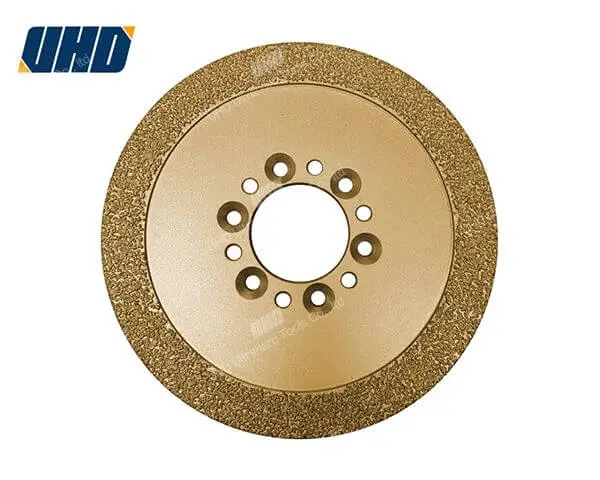
The brazing process plays a crucial role in ensuring the uniformity and dynamic balance of the saw blade. A high - quality brazing process can firmly bond the diamond segments to the matrix, ensuring even distribution of cutting forces. This helps maintain the dynamic balance of the saw blade during rotation. For example, our advanced brazing technology can reduce the vibration amplitude by up to 30% compared to traditional methods.
When you encounter vibration problems, you can perform on - site diagnostics. First, check the fixture fastening. A loose fixture can cause the saw blade to move during cutting, resulting in vibration. Second, calibrate the spindle run - out. A spindle with excessive run - out can also lead to uneven cutting and vibration. You can use a dial indicator to measure the spindle run - out, and the allowable deviation should be within 0.05mm.
Our Youde 400H brazed diamond saw blades are designed with advanced vibration reduction and noise reduction technology. Through optimized structure design and high - quality brazing process, these saw blades have excellent dynamic stability. In practical tests, the Youde 400H saw blades reduced vibration by 40% and noise by 20% compared to ordinary saw blades, greatly improving the cutting efficiency and safety.
Don't let saw blade vibration problems affect your work efficiency and safety. Discover the superior vibration reduction technology of Youde 400H saw blades. Click here to learn more details.





.png?x-oss-process=image/resize,h_600,m_lfit/format,webp)
.png?x-oss-process=image/resize,h_600,m_lfit/format,webp)