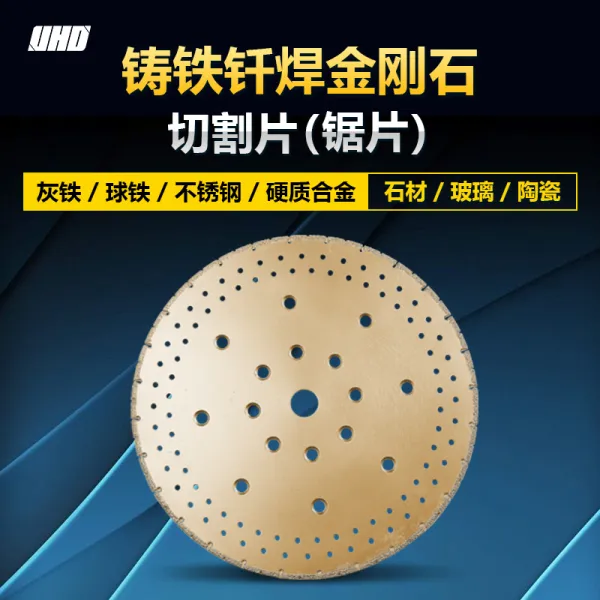
For construction professionals and industrial buyers, the choice of cutting tools directly impacts productivity, safety, and operational costs. Many users still rely on traditional welded diamond blades—yet they often face recurring issues like premature blade failure, inconsistent cuts, and excessive heat buildup during operation.
According to a 2023 study by the International Construction Tools Association (ICTA), over 67% of users report blade edge chipping or cracking within 4–6 hours of continuous use with standard welded blades. This leads to frequent downtime, rework, and higher material waste—especially when cutting hard materials like granite or reinforced concrete.
| Performance Metric | Traditional Welded Blade | Enhanced Brazed Blade (400H) |
|---|---|---|
| Average Lifespan (hours) | 8–12 | 25–35 |
| Temperature Rise (°C after 30 min) | 180–220 | 90–130 |
| Cutting Accuracy (mm deviation) | ±2.5 | ±0.8 |
You may have experienced this yourself: a sudden blade breakage mid-cut, wasted time resetting equipment, or even safety risks due to overheating. These aren’t just inconveniences—they’re avoidable losses in your project timeline and budget.
Unlike traditional welding—which melts the blade body to attach diamonds—the enhanced brazing process uses a high-temperature alloy filler metal that bonds at lower temperatures (~600°C vs. 800–900°C). This preserves the structural integrity of both the steel core and the diamond particles, resulting in stronger adhesion and less stress concentration.
“Our lab tests show that enhanced brazed blades maintain up to 92% of their original cutting efficiency after 30 hours of continuous use—compared to only 60% for traditional welded ones.”
— Material Testing Lab, Shanghai Institute of Industrial Materials
In real-world applications—from marble fabrication shops in Italy to highway repair crews in the UAE—users consistently note reduced vibration, smoother cuts, and fewer tool changes. The improved thermal management also means you can run dry-cutting operations longer without risking blade deformation or motor damage.
If your team spends 20% of daily work hours replacing or repairing blades, switching to an enhanced brazed solution could reduce those costs by up to 40%. That’s not just about saving money—it’s about improving workflow predictability, reducing labor friction, and building trust with clients who demand precision.
And because our blades meet CE certification standards for mechanical safety and environmental compliance, they’re ready for deployment across EU markets without additional testing or import delays.





.png?x-oss-process=image/resize,h_600,m_lfit/format,webp)


.png?x-oss-process=image/resize,h_600,m_lfit/format,webp)