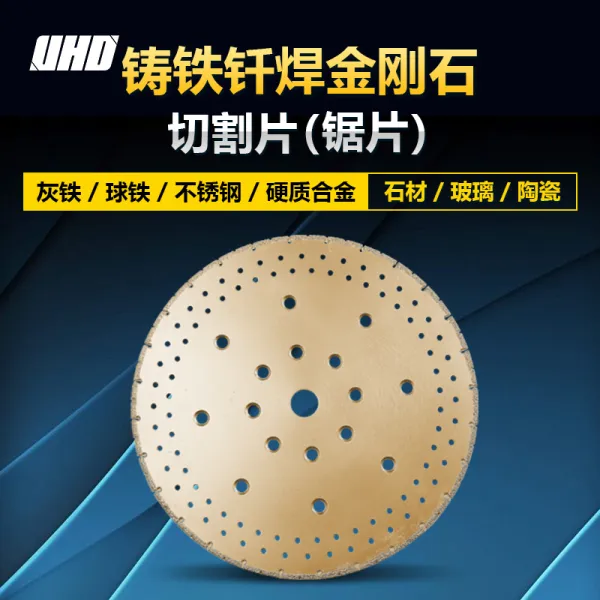
Why High-Quality Brazed Diamond Saw Blades Offer Superior Stability: Key Factors in Vibration Control
2025/11/16
Industry Research
This article explores why premium brazed diamond saw blades exhibit enhanced stability by analyzing vibration causes across mechanical balance, tooth profile optimization, and overall rigidity. It reveals how advanced brazing processes improve dynamic balance, mitigating high-frequency vibrations that affect cutting precision and equipment safety. Combining practical on-site adjustment techniques and real-world application cases, this guide helps you quickly diagnose and resolve common vibration issues for more efficient and safer cutting. The Yude 400H brazed diamond saw blade, renowned for its innovative structural design and stringent manufacturing standards, stands as a trusted high-performance solution for industrial users.
Why High-Quality Brazed Diamond Blades Deliver Superior Stability: An Industry Insight into Vibration Control
In the precision-driven world of industrial cutting, understanding the underlying factors of saw blade vibration is pivotal. Vibrations in brazed diamond saw blades not only compromise surface finish and cutting accuracy but also accelerate wear on equipment, jeopardizing operational safety. This article explores the critical elements that contribute to the exceptional stability of brazed diamond blades, focusing on the interplay of mechanical balance, tooth geometry optimization, and overall structural rigidity.
The Hidden Costs of Blade Vibration: Impact on Quality and Safety
Excessive vibration during cutting generates several adverse effects:
- Surface imperfections such as chipping, micro-cracks, and unevenness, leading to costly rework.
- Premature blade and machinery wear, reducing the lifecycle by up to 30% compared to stable operation.
- Increased risk of operator injury due to unpredictable blade movement and reduced control.
Mechanics Behind Stability: Three Pillars of Vibration Control
High-grade brazed diamond blades incorporate a multi-faceted approach to vibration mitigation:
| Key Dimension |
Vibration Control Mechanism |
Industry Impact |
| Mechanical Balance |
Precision mass distribution reduces dynamic imbalance and minimizes centrifugal forces. |
Up to 40% reduction in high-frequency vibrations, enhancing cut smoothness. |
| Tooth Profile Optimization |
Custom-engineered tooth angles and spacing to dissipate oscillations during engagement with hard materials. |
Improved chip clearance reduces resistance, boosting feed rate by 15-20%. |
| Structural Rigidity |
Reinforced core and brazed joint integrity maintain blade stiffness under load. |
Limits blade deflection to less than 0.1 mm during intensive cuts, enhancing dimensional accuracy. |
Brazing Technology: The Cornerstone of Uniformity and Stability
The brazing process fuses diamond segments to the steel core under controlled temperature and pressure, achieving superior adhesion and uniform segment distribution. High-quality brazed blades benefit from:
- Consistent segment height and alignment, preventing uneven cutting forces.
- Enhanced thermal conductivity, dissipating heat buildup to reduce distortion.
- Microstructural homogeneity, ensuring segment integrity for prolonged cutting cycles.
These factors combine to elevate the blade’s dynamic balance score by 25-30% compared to conventional methods, significantly suppressing resonance frequencies that cause vibration.
Practical On-Site Vibration Mitigation: Installation and Maintenance Tips
Even the best blade requires proper handling to deliver peak performance. Consider these best practices during installation and maintenance:
- Clamp Fixture Inspection: Ensure clamping surfaces are burr-free and flat to prevent lateral wobble.
- Spindle Runout Calibration: Limit spindle eccentricity within 0.01 mm to avoid induced vibrations.
- Regular Blade Cleaning: Remove debris buildup between diamond segments to reduce asymmetric mass distribution.
- Periodic Balancing Checks: Implement dynamic balancing tests every 50 cutting hours or after segment replacements.
Performance Across Materials: From Concrete to Granite
Different materials pose unique vibration challenges when cut:
| Material |
Vibration Source |
Optimized Blade Features |
| Concrete |
Heterogeneous aggregates create irregular load spikes. |
Segment serrations and vibration damping cores. |
| Granite |
Hardness causes micro chipping and shockwaves. |
Diamond grit size and brazing thickness adjusted for shock absorption. |
| Marble |
Smoothness reduces vibration but sensitive to thermal loads. |
Heat dissipating cores and controlled feed rates. |
Addressing Common Questions from Industry Users
-
Q: Why does a new blade sometimes vibrate excessively?
-
A: Even brand-new blades may exhibit vibration due to improper mounting, spindle runout beyond tolerance, or lack of initial dynamic balancing. Always perform proper installation checks before operation.
-
Q: Is periodic maintenance necessary to maintain vibration control?
-
A: Absolutely. Regular cleaning, checking for segment wear, and dynamic balancing every 50-100 hours of operation help sustain blade stability and extend service life.





.png?x-oss-process=image/resize,h_600,m_lfit/format,webp)

.png?x-oss-process=image/resize,h_600,m_lfit/format,webp)
.png?x-oss-process=image/resize,h_600,m_lfit/format,webp)